There are so many famous giant stone statues in the world. The Sphinx in Egypt is one, the carved building front in Petra is another. We hear about all these wonders and marvels as they are featured in movies, documentaries and on the cover of National Geographic.
But there is one stone marvel I had never heard of before. It is not only a huge carving, but the largest stone Buddha in the world called Dafo.
The Leshan Giant Buddha is an amazing sight. He is carved on the side of a mountain, his ancient body covered in lichen and mosses, showing signs of erosion over the centuries. His view is the river, or more specifically, the convergence of three rivers which was a notorious spot for killing fishermen.
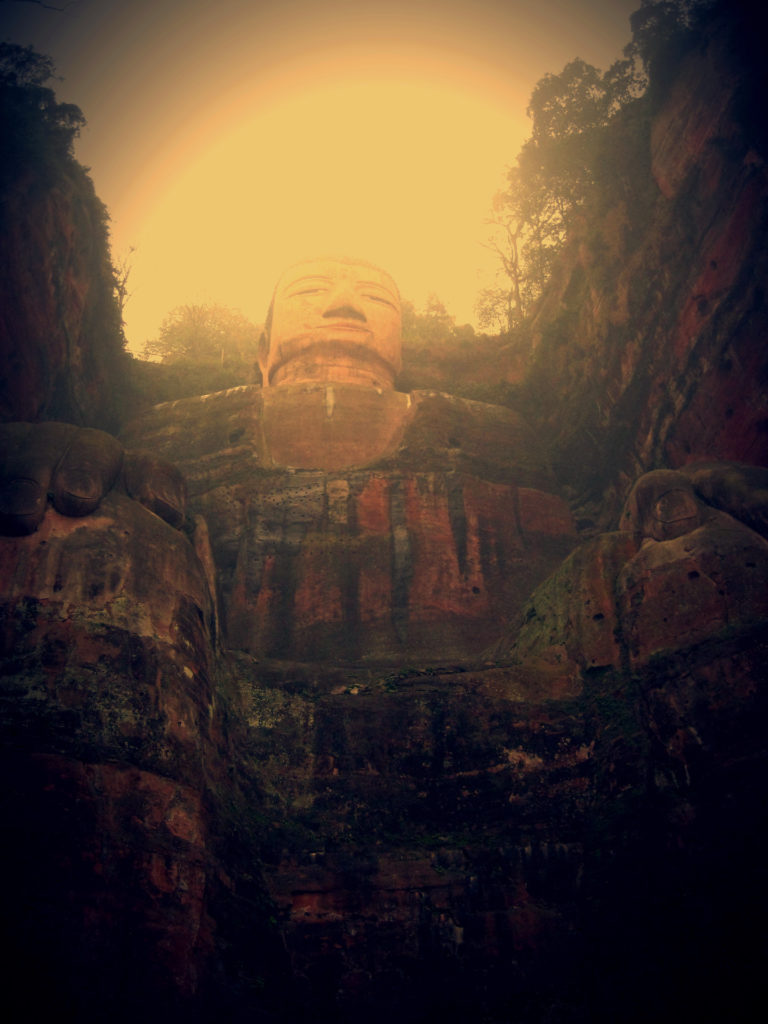
The Buddha is the brain child of a monk named Haithong in the year 713. The water was very rough in the area which killed many fisherman every year. The local people thought there was an evil water spirit so Haithong thought a Buddha statue that would eliminate the spirit and protect the fisherman.
Haithong might not be a famous name, but he sounds like one bad motherf**ker. He begged for money for 20 years before he could start building and as soon as he had a wad of cash some local officials approached him demanding the money. The story goes that instead of giving them the money he single-handedly, pulled out his eyeballs saying, ‘You may have my eyes, but you can never touch the money for Buddha!’ The official, thoroughly freaked out, left immediately and Haothong started his project. I don’t know if that story is true, but what a bad ass, eh?!

The Buddha took thousands of people and 90 years to build. Haithong didn’t live to see it completed but amazingly the Buddha did what he was created for. The waters, so notorious for deaths, calmed and the fisherman were safe from the spirit. Of course, it might have had a little something to do with all the extra rock being thrown into the river, giving it a smooth bottom therefore eliminating the hallows on the river bed which was making the water so turbulent. But who’s to say really….
The Buddha was also carved with some impressive skills. There are some hidden internal drainage systems to protect it from erosion. There are 1021 buns in his coiled hair each individually made and attached seamlessly. The ears look like stone but are actually wooden, covered with mud. Somehow, they managed to affix these flawlessly as well.

You can take a thin, steep staircase, down, down, down to get to the feet of the statue and feel how big it really is. (Then you gotta take another staircase up, up, up. This can get more congested as people need to take a break.) They say in summer and holidays it can take hours to get to the bottom due to the crowds. Luckily we went in the middle of the week so we were down in less then 10 minutes. On the wall is carved many small Buddhas in alcoves that have eroded over time.

The Buddha isn’t the only impressive thing in this area. You don’t get the world’s biggest stone Buddha without a while network of ancient temples and villages nearby. We walked around for hours, stumbling upon a small ancient fisherman village (which is now home to souvenir stalls and little restaurants) crossed an amazing bridge and found ourselves at an ancient Buddhists temple complete with burning incense and yellow robed monks. There were also burial chambers, caves to explore and some amazing quiet natural spots (which I hard to come by especially in a tourist spots.)

All in all, it was an amazing area and one I highly recommend you visit if you find yourself in the area. We didn’t go out in a boat so I found this full picture of the Buddha on Wikipedia. For us it was impossible to capture the full figure so well because of our small camera and our close distance. Ladies and gentlemen, I introduce to you….dafo!

Leave a Reply